Gov Bob Riley On Water Wars And Lake Martin
Alabama Governor Bob Riley has recently played a huge role in lobbying FERC on behalf of Lake Martin’s water level. He is also Alabama’s most visible representative in the ongoing “Water Wars” – the struggle of Georgia, Florida, and Alabama to determine the future water usage of each state, and how that impacts the other two.
The Guv recently spoke to the Montgomery Lions Club, of which I am a member. He spoke on a variety of topics, then opened the floor for questions. Since I am keenly interested in feeding my children, I asked:
“What is the update on the Water Wars?”
Thankfully, The Guv limited his response to include some examples that affect Lake Martin. Namely he talked about how the recent drought caused Georgia to nearly suck their lakes dry, which of course directly and indirectly affected water flow into Alabama, and therefore Lake Martin.
He made two interesting points that cause me to have hope for Alabama’s
(and Lake Martin’s) negotiating positions:
1. Georgia’s reservoirs (like Lake Lanier) were built by the Federal Government. Not a private company (Martin dam was built by Alabama Power) or even the state government. Since federal tax dollars were used to build those dams, don’t they belong just as much to the citizens of Alabama and Florida as the citizens of Georgia?
2. Apparently all of these dam projects must have charters where they state the purpose for building the dam in the first place. In my deliberately cursory and extremely biased review of the COE site, I saw no mention of using the water for watering golf courses in Buckhead, water amusement parks by ATL, or boiling hot dogs at The Varsity. To the contrary, their charters state that among their purposes is to regulate water flow to navigable rivers. True, Lake Lanier and Lake Martin are on two different watersheds. But I think the Guv was trying to point out the inherent responsibility of downstream flow when the Georgia lakes were built.
I realize that this is a huge subject, with points and counter points on all three states’ sides. The above two items hardly encompass the entire argument. I also realize that it is possible that I misunderstood Gov. Riley, however hard I tried not to just hear the good news selectively.
But, I do feel confident that Lake Martin stands a great chance of coming out of this with more than we started with, such as a higher winter water level.
Do any of you out there in Lake Martin readerland have more to add to this topic? Please click “Continue” and then “Leave A Reply.” I am sure that others would benefit from your comments.
Do you enjoy the sparkling, fresh-as-a-daisy posts of Lake Martin Voice? Would you like an email notification of each new entry? Then type your real email address in the yellow box in the upper right corner to receive a spam-free notification. Or if you’re lazy like me, get hip to RSS and then click on the Lake Martin Voice RSS feed.

Lake Martin Real Estate MLS Statistics - 2007 In Review
The Lake Martin real estate market suffered a major slowdown in 2007 for a variety of reasons. I dug through the sales results in the Lake Martin MLS to attempt to cut through the gossip and analyze the numbers.
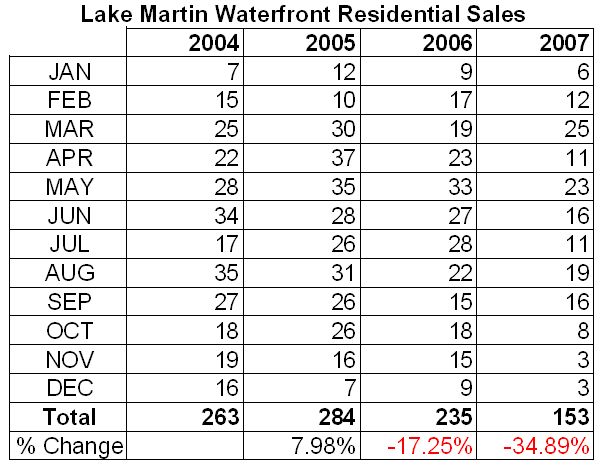
In 2007, the number of Lake Martin waterfront homes sold was about 35% less than in 2006. 2006 was about 17% less than the peak of the sellers’ market in 2005:

Witness the Transformation From Sellers’ to Buyers’ Market:
In 2006 and 2007, the number of Lake Martin waterfront homes that were added as new listings to the market out paced those that were actually sold every month. Therefore sales inventories ballooned, and this 24 month period proved crucial:

More Analysis Of Waterfront Homes Sold in 2007:
153 Lake Martin homes sold in 2007. Of those, 114 were homes and 39 were condos. Of the 153, 142 were deeded lot homes and 11 were leased lot homes.
Prices of Homes Sold in 2007:
Of the 153, 13 homes were listed as having sold at $0. This happens sometimes. Most of the time it is at the request of the seller. A minority of people don’t want “their business” on the MLS. Sometimes it is a builder that doesn’t want to publish how far he dropped the price. So the below statistics will only deal with the 140 that sold and published prices:

The most expensive home sold was for $3.88 million in The Ridge. The lowest was a manufactured home on a leased lot in Pleasure Point for $25,000.
LOTS:
Sales of waterfront lots on Lake Martin were also affected in 2007. In total, 37 lots were sold in 2007, as compared to 55 in 2006. The monthly sales numbers are:

As the numbers point, out, now is a great time to buy Lake Martin waterfront real estate. Do you need help finding the best deal? Let me show you around..
Or do you own Lake Martin property, and are wondering how all of this news affects your particular situation? Call me, I will be glad to give you an idea of how the changing real estate market will translate to your bottom line. No cost, no pressure, no kidding.
Still curious about Lake Martin real estate statistics? Leave a reply below and suggest how you would like me to slice and dice the numbers.
Disclaimers: All of the above info was taken from the Lake Martin Area Association of Realtors’ Multiple Listing Service. Accuracy is not guaranteed but deemed reliable. The above does not include sales by FSBOs or developers that sell privately and not through the MLS. But, I do think that the above represents a very large majority of all sales on Lake Martin.
Lake Martin Real Estate Spotlight: Trillium

Trillium, one of Russell Lands’ more mature Lake Martin developments, is located just west of Kowaliga Marina. Along with Willow Point and The Ridge, Trillium has some of the more high end homes on Lake Martin.
Trillium was one of Russell Lands’ first neighborhoods that were completed in different phases. The first homes were built there around 1989. One element that was new to Lake Martin at the time was Russell Lands’ use of causeway construction.
Years of erosion on Lake Martin had made islands out of former peninsula. Russell Lands poured a lot of money in the construction of causeways to bring paved roads and utilities, thereby rescuing millions of dollars of real estate. I can remember one such “island” on the first phase. It was divided into four huge lots and priced at $250,000 each. It was laughingly dubbed “million dollar island” by hordes of us skeptical locals. We pondered “what fool would pay that much for one lot?” Eighteen years later, that amount will barely buy you any sort of waterfront lot, much less a showcase one like those on the points at Trillium. Turns out that we were the fools for not realizing the demand that would spur a long bull run for Lake Martin property. Lots like those would now cost you 10 times that amount if you could buy them at all.
By my unofficial count, there are 213 waterfront lots in all of Trillium. As of this writing, there are 8 homes and 4 lots for sale in Trillium in the Lake Martin MLS. If you would like any information on them, give me a call or email me.

Amenities:
Trillium does not have a clubhouse. It does have a guardhouse protecting the lone entry, but I have never seen a guard there. I suppose they could put someone there in the future if they wanted.
Because Trillium doesn’t have a clubhouse, it does not have any related things like a pool or workout center or anything. They do have some walking trails that are cut through the non-waterfront woods.
Lot types:
Waterfront lots in Trillium are flat. Just as many of the lots in The Ridge (link) are sloped, Trillium’s overall topography almost guarantees that each one of its lots are flat.
Generally, the lots are also big (for Lake Martin) and deep, sitting far back from the roadways. Trillium’s lots are also well covered with tall, mature pines.
There are no interior lots or homes. All homes in Trillium are waterfront. Who knows, maybe one day Russell Lands will sell off the interior land. Right now, they have retained fairly large sections of woods in between the phases to give Trillium a beautiful, woodsy, private feel.
Factoids:
Back in the heyday of “Russell cabins” Mrs. Edith Russell used to have a couple of cabins at the end of Pine Point. Apparently she was a fan of the trillium, a pretty, symbolic wildflower native to this part of Alabama. Hence the name of the subdivision and its types the names of many of its streets: Wake Robin, Nodding, Grandiflorium, Underwood, Catesby, and Narrowleaf.
Local Lending Would Have Helped Mortgage Mess
The Lake Martin real estate market has not really felt a direct effect of the mortgage meltdown yet. Sure, the subprime fiasco has caused conventional and jumbo rates to rise, but I consider that indirect. By direct effect I mean huge waves of foreclosures from high risk loans, and we haven’t really seen that on Lake Martin up to this point. I don’t think we will see as much of that here as was seen in other markets, because I don’t think that many of the 2004 and 2005 sales were fueled by speculators. A quick trip to the Tallapoosa County Courthouse last week confirmed the low foreclosure rate.
This is not true of other markets around the nation. Headlines like this abound: “Fraud Seen As Major Driver In Wave Of Foreclosures.” In a subject this big, there is a lot of blame to go around: borrowers who falsify their income to buy a home they know they cannot afford, unscrupulous realtors selling for commissions instead of trying to educate clients on wise home buying, dial-a-dollar appraisers who will sell their integrity for $400 a pop, and downright dirty mortgage brokers who churn up new paper and burn families in their wake.
Basically, in many of the cases I think much of this could have been avoided if buyers had stuck with local lenders.
I know this sounds naive of me. Sure, the mortgage industry has changed in the past 10 years.
I know, I know, huge national companies can loan you money no matter where you buy, from Alaska to Port Orange. Sure, because of the internets they can offer low low rates with no no documentation.
So why go with your local yokel lender?
And how would local lending would have helped this mess?
First of all, it’s true, huge national companies can make mortgage loans anywhere with great rates. But the opposite is also true - local banks can tap national rate markets, and almost always match the best rate you can find on the internet. Plus their closing costs are usually lower, at Lake Martin, or anywhere else.
Secondly, more local lending would have helped because it’s human nature to care more about the person you know than you do about some number that’s three states away. If you’re a buyer, would you try to convince your local banker that you can afford a caviar home when she knows you can barely make the payments on your Gremlin? And if you’re a mortgage lender, how willing would you be to give a buyer a loan that you know you will have to foreclose in three months, if your wives are in the same bunko group? If you’re an appraiser who’s on the edge, wouldn’t it be easier to lie to an out of state lender versus one that you sit by at every Friday night football game?
I am not suggesting that we all turn the clock back 40 years and only deal with the bank on the corner and that we all have a credit account at the Feed n Seed. Shareholders pressure banks to make lots of loans, and to do that, they must venture out of state. I get that. But maybe this latest mortgage scare will cause lenders to return to common sense lending.